Language Learning Statistics 2026
How this page was made. Every figure links to its source and was last checked on November 5, 2026. Lingostar has no first-party data here and claims no hands-on testing. Method and limits are in the methodology.
This page collects 146 language learning statistics across 13 topics, from speaker counts and school enrollment to exam demand and the app business. Each figure links to the page it came from and carries a year: the year the data describes, or the year we read it where the page gives no date. All figures were last verified on November 5, 2026.
Key takeaways
- Ethnologue counts 7,170 languages in use, and roughly 44% of them are endangered.
- In 2024, 89.4% of EU upper secondary pupils studied English, and 49% learned two or more foreign languages.
- Only 43% of US public schools offered world language classes in January 2024, including 20% of elementary schools.
- US college language enrollments fell 16.6% from 2016 to 2021, while Korean rose 38.3%.
- Spanish had 132,680 provisional GCSE entries in England in 2026, ahead of French at 121,040.
- Duolingo averaged 64.9 million daily users in Q3 2026, up 29%, while paid subscribers grew 14% to 13.1 million.
- The US Foreign Service Institute usually expects 552-690 class hours for Category I languages such as Spanish, and 2200 for Japanese, Korean, Arabic or Mandarin, to reach ILR level 3.
The world’s languages and their speakers
A small group of languages covers most of humanity, while nearly half of all languages are at risk.
- Ethnologue counts 7,170 languages in use today, a total it says is constantly changing. Ethnologue, How many languages are there, data year 2026.
- Ethnologue estimates that roughly 44% of all languages are endangered, often with fewer than 1,000 users remaining. Ethnologue, How many languages are there, data year 2026.
- The world’s 20 largest languages are the native tongue of more than 3.7 billion people, according to Ethnologue. Ethnologue, How many languages are there, data year 2026.
- Those 20 largest languages are just 0.3% of the world’s languages, yet account for nearly half of the global population. Ethnologue, How many languages are there, data year 2026.
- Over 88% of people use one of the 200 languages on the Ethnologue 200 list as their native tongue. Ethnologue 200, 2026 list, data year 2026.
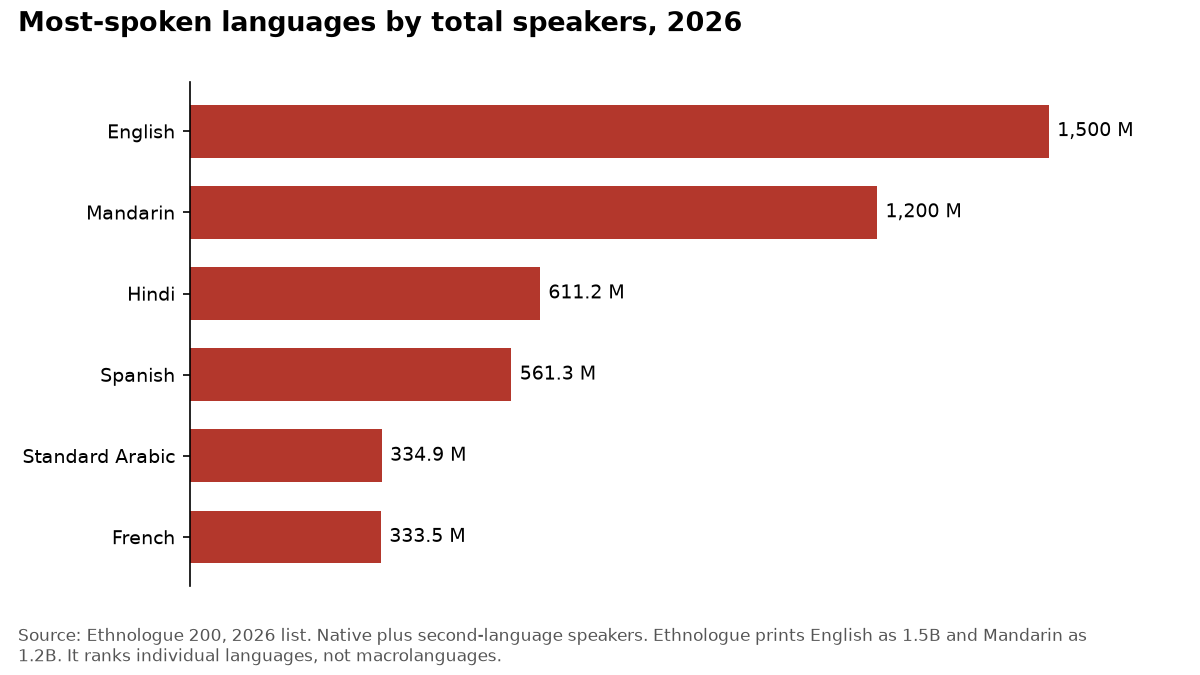
- English ranks first on the 2026 Ethnologue 200 with 1.5B total speakers, counting native and second-language users. Ethnologue 200, 2026 list, data year 2026.
- Mandarin Chinese ranks second on the 2026 Ethnologue 200 with 1.2B total speakers. Ethnologue 200, 2026 list, data year 2026.
- Hindi ranks third on the 2026 Ethnologue 200 with 611.2M total speakers. Ethnologue 200, 2026 list, data year 2026.
- Spanish ranks fourth on the 2026 Ethnologue 200 with 561.3M total speakers. Ethnologue 200, 2026 list, data year 2026.
- Standard Arabic ranks fifth on the 2026 Ethnologue 200 with 334.9M total speakers. Ethnologue 200, 2026 list, data year 2026.
- French ranks sixth on the 2026 Ethnologue 200 with 333.5M total speakers. Ethnologue 200, 2026 list, data year 2026.
- UNESCO’s International Mother Language Day page states that 40 per cent of the global population lacks access to education in a language they speak or understand. UNESCO, International Mother Language Day, data year 2026.
How many people are learning each language
Official learner counts exist for several major languages, but each uses its own definition, so they should not be read as a league table.
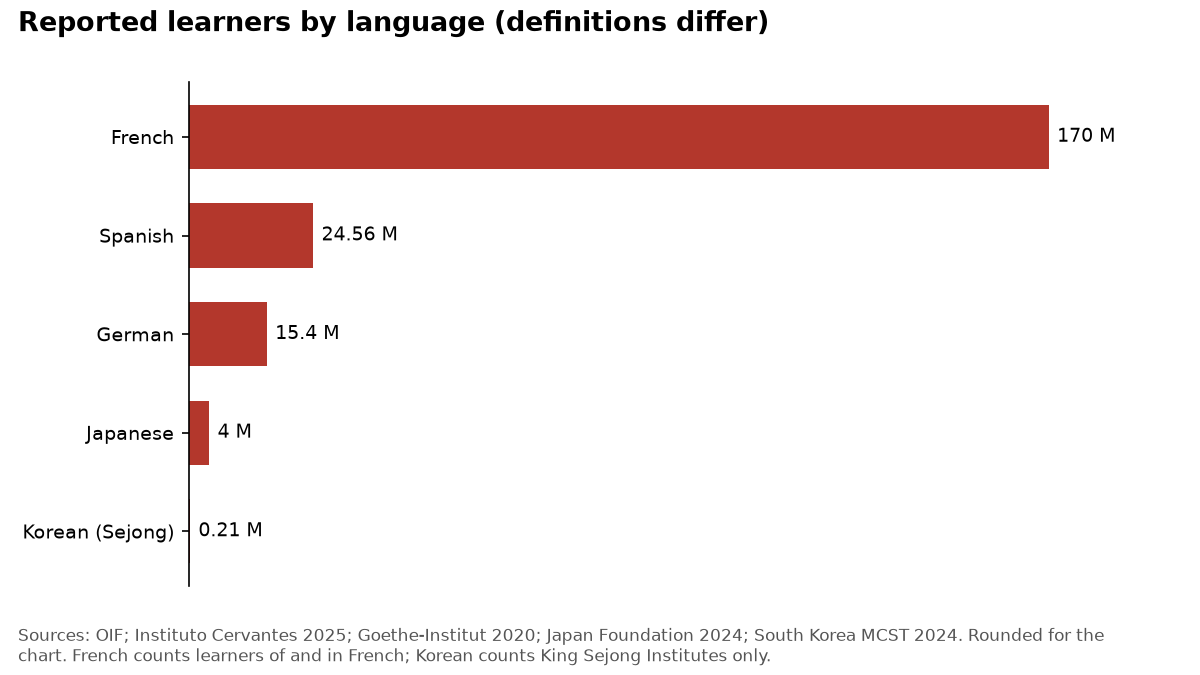
- The Japan Foundation’s 2024 survey counted 4,000,750 Japanese-language learners at institutions outside Japan, the highest figure it has recorded. Japan Foundation, Survey on Japanese-Language Education Abroad 2024, data year 2024.
- Japanese-language education was confirmed in 143 countries and regions in the Japan Foundation’s 2024 survey. Japan Foundation, Survey on Japanese-Language Education Abroad 2024, data year 2024.
- The same survey found 19,344 institutions teaching Japanese outside Japan in 2024. Japan Foundation, Survey on Japanese-Language Education Abroad 2024, data year 2024.
- Japanese learners abroad rose by 5.4% between the 2021 and 2024 Japan Foundation surveys, an increase of 206,036 people. Japan Foundation, Survey on Japanese-Language Education Abroad 2024, data year 2024.
- China had the most Japanese learners in 2024 at 1,019,197, down 3.6% from 2021. Japan Foundation, Survey on Japanese-Language Education Abroad 2024, data year 2024.
- South Korea had 555,396 Japanese learners in 2024, up 18.1% from 2021. Japan Foundation, Survey on Japanese-Language Education Abroad 2024, data year 2024.
- The United States had 134,096 Japanese learners at surveyed institutions in 2024, down 16.9% from 2021. Japan Foundation, Survey on Japanese-Language Education Abroad 2024, data year 2024.
- Myanmar’s Japanese learners reached 100,315 in 2024, up 424.6% from 2021. Japan Foundation, Survey on Japanese-Language Education Abroad 2024, data year 2024.
- Asian learners account for almost 80% of Japanese learners outside Japan, according to the 2024 survey. Japan Foundation, Survey on Japanese-Language Education Abroad 2024, data year 2024.
- Instituto Cervantes counts 24,560,143 people learning Spanish as a foreign language in its 2025 report. Instituto Cervantes, El español: lengua para el mundo 2025, data year 2025.
- The Organisation internationale de la Francophonie reports 170 million learners of and in French, a count that includes people taught in French. Organisation internationale de la Francophonie, data year 2026.
- More than 15.4 million people worldwide were learning German as a foreign language in the 2020 Deutsch als Fremdsprache weltweit survey. Deutsch als Fremdsprache weltweit 2020 (German Federal Foreign Office and partners, via Goethe-Institut), data year 2020.
- About 106,000 schools offered German in the 2020 survey, up from 95,000 in 2015. Deutsch als Fremdsprache weltweit 2020 (German Federal Foreign Office and partners, via Goethe-Institut), data year 2020.
- A total of 210,374 students studied Korean at King Sejong Institutes in 2024, compared with 740 students per year when the first institute opened in 2007. South Korea Ministry of Culture, Sports and Tourism, data year 2024.
- South Korea’s culture ministry said 252 King Sejong Institutes across 87 countries would offer classes after its 2025 designations. South Korea Ministry of Culture, Sports and Tourism, data year 2025.
Why speaker counts disagree
Spanish and French totals change by tens of millions or more depending on who counts and what they include.
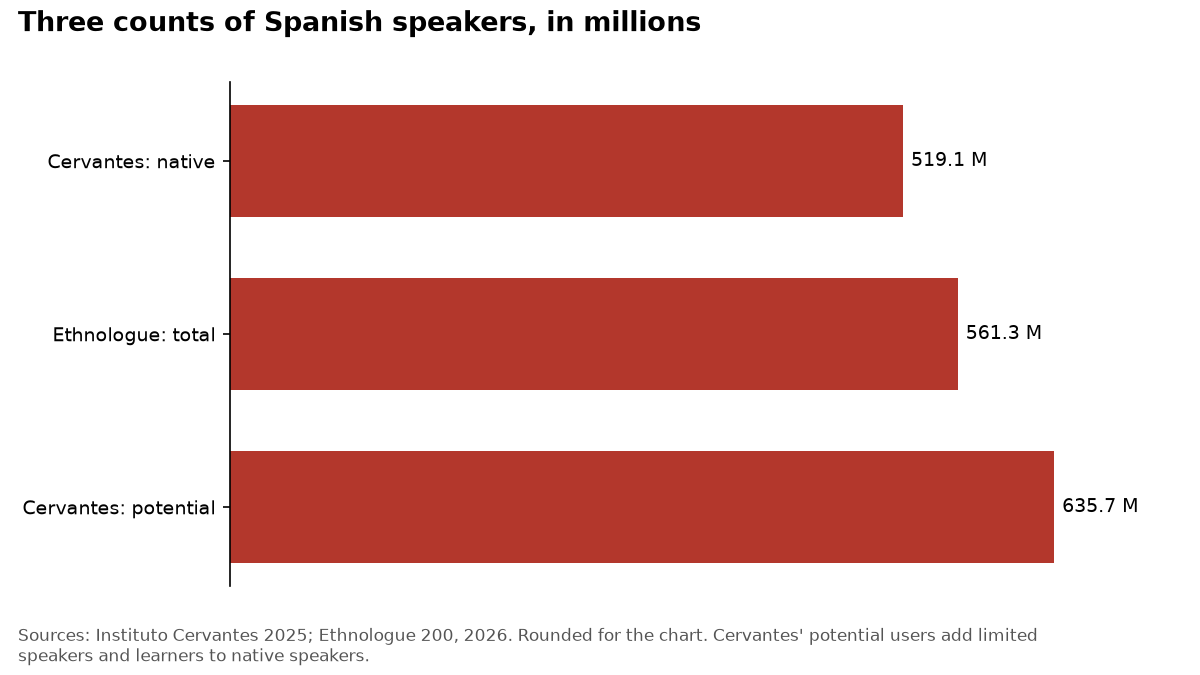
- Instituto Cervantes counts 635,743,644 potential users of Spanish worldwide in 2025. Instituto Cervantes, El español: lengua para el mundo 2025, data year 2025.
- Of those, 519,115,258 people have native command of Spanish, according to Instituto Cervantes. Instituto Cervantes, El español: lengua para el mundo 2025, data year 2025.
- Instituto Cervantes counts 92,068,243 users of Spanish with limited competence in 2025. Instituto Cervantes, El español: lengua para el mundo 2025, data year 2025.
- Cervantes’ 635,743,644 potential users is about 74.4 million higher than Ethnologue’s 2026 total of 561.3M in stat 9 (635.7M minus 561.3M). The two use different scopes and methods. Instituto Cervantes, El español: lengua para el mundo 2025, data year 2025.
- The Spanish native-speaker count grew 22% between 2012 and 2025, though Cervantes notes its yearly series is affected by method changes and data revisions. Instituto Cervantes, El español: lengua para el mundo 2025, data year 2025.
- The count of people with limited competence in Spanish grew 79% since 2012, which Cervantes links to Spanish teaching in Europe, the US and Brazil, in the same revised series. Instituto Cervantes, El español: lengua para el mundo 2025, data year 2025.
- The count of Spanish learners grew 36% since 2012, according to the same revised Instituto Cervantes series. Instituto Cervantes, El español: lengua para el mundo 2025, data year 2025.
- Spanish learner numbers grew 1.5% between 2024 and 2025, according to Instituto Cervantes. Instituto Cervantes, El español: lengua para el mundo 2025, data year 2025.
- The European Union is home to more than 45 million Spanish speakers outside Spain, according to Instituto Cervantes. Instituto Cervantes, El español: lengua para el mundo 2025, data year 2025.
- The Organisation internationale de la Francophonie reports 396 million French speakers, a higher total than the Ethnologue figure in stat 11. Organisation internationale de la Francophonie, data year 2026.
What people study on language apps
On Duolingo, English ranks first in most countries, while Japanese and Korean have climbed past older favourites. This reflects Duolingo’s users, not all learners.
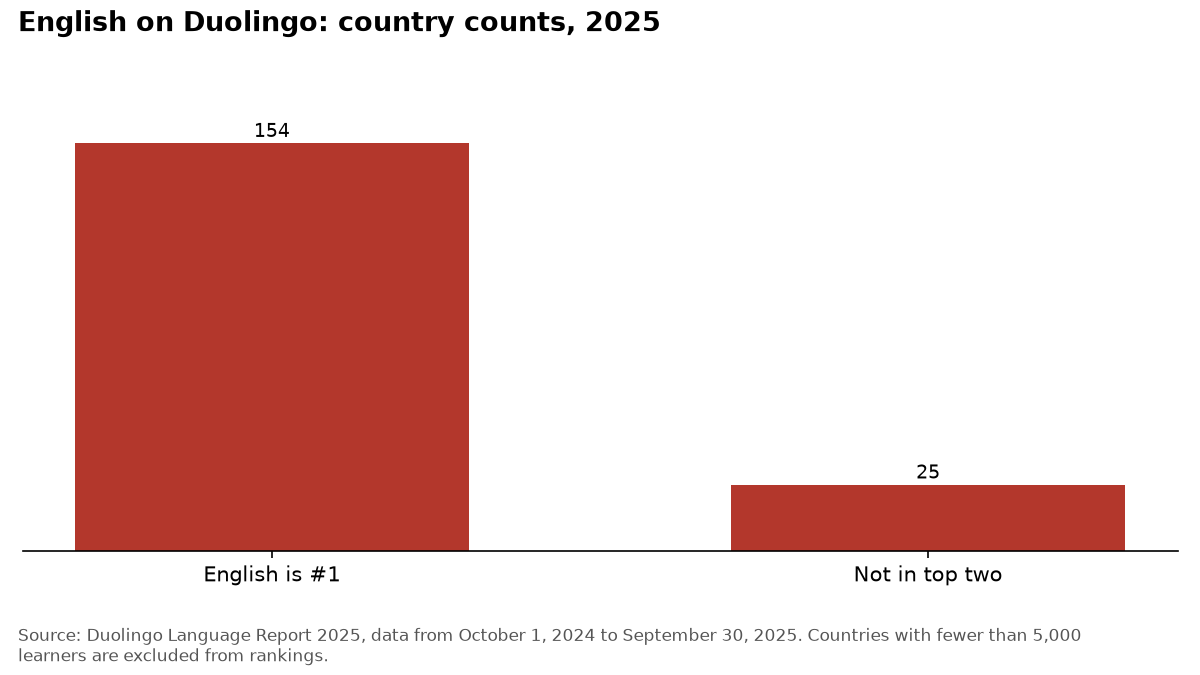
- English is the most-studied language on Duolingo in 154 countries, according to the 2025 Duolingo Language Report. Duolingo Language Report 2025, data year 2025.
- Duolingo’s 2025 report says English is the most-studied language in 79% of all countries. Duolingo Language Report 2025, data year 2025.
- The count of countries where English ranks first on Duolingo rose 14% over 2024. Duolingo Language Report 2025, data year 2025.
- There are just 25 countries where English is not among the top two languages on Duolingo. Duolingo Language Report 2025, data year 2025.
- Japanese became the fourth most popular language to study on Duolingo globally in 2025, passing German. Duolingo Language Report 2025, data year 2025.
- Korean became the sixth most popular language on Duolingo in 2025 (#6), moving past Italian. Duolingo Language Report 2025, data year 2025.
- People from 219 countries took the Duolingo English Test in 2025. Duolingo Language Report 2025, data year 2025.
- Test takers for the Duolingo English Test in 2025 had 148 first languages. Duolingo Language Report 2025, data year 2025.
- Asia accounted for 55% of Duolingo English Test sessions in 2025. Duolingo Language Report 2025, data year 2025.
- Africa’s share of Duolingo English Test sessions rose from 7% to 8.3% in 2025. Duolingo Language Report 2025, data year 2025.
- Over 19% of Duolingo’s Latin learners also study chess, 14% study math and 13% study music. Duolingo Language Report 2025, data year 2025.
Language learning in European schools
English is near universal in EU lower secondary schools and reaches about 9 in 10 upper secondary pupils, but only about half of those pupils learn two or more foreign languages.
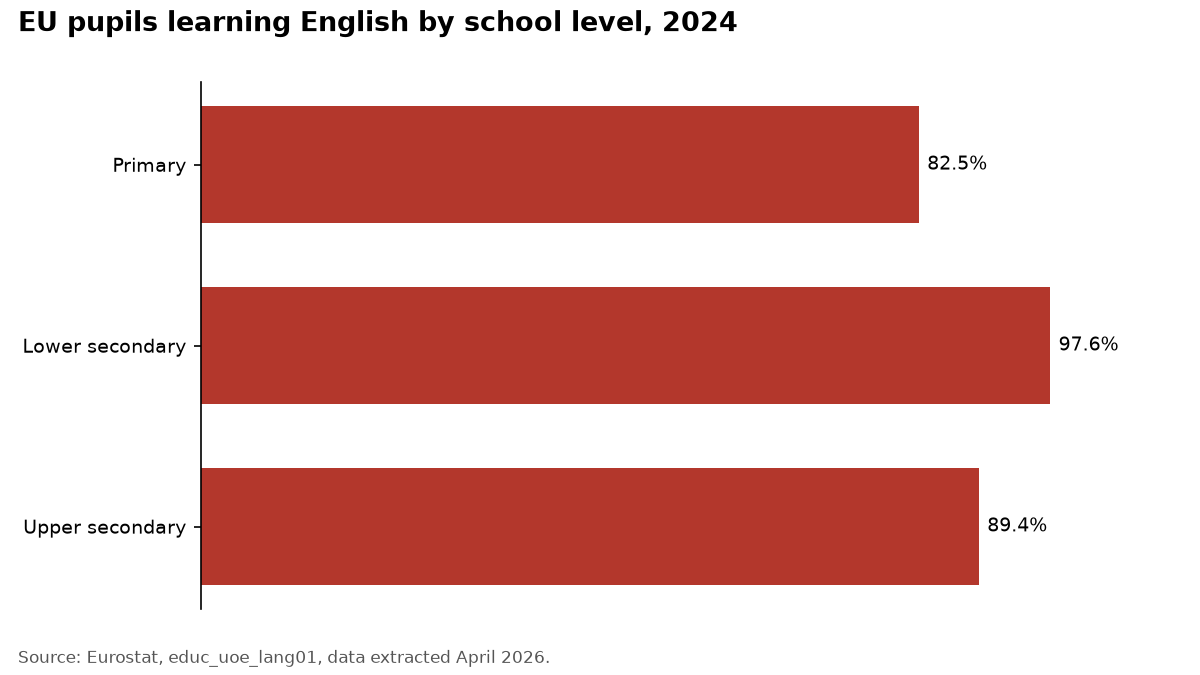
- In 2024, 82.5% of EU primary pupils were learning English. Eurostat, Foreign language learning statistics, data year 2024.
- In 2024, 97.6% of EU lower secondary pupils were learning English. Eurostat, Foreign language learning statistics, data year 2024.
- In 2024, 89.4% of EU upper secondary pupils were studying English as a foreign language. Eurostat, Foreign language learning statistics, data year 2024.
- Among EU upper secondary pupils in 2024, 96.3% in general programmes learned English, compared with 81.1% in vocational programmes. Eurostat, Foreign language learning statistics, data year 2024.
- Nearly half (49%) of EU upper secondary pupils learned two or more foreign languages in 2024, excluding Czechia. Eurostat, Foreign language learning statistics, data year 2024.
- Only 6.4% of EU primary pupils learned two or more foreign languages in 2024, up from 4.6% in 2014. Eurostat, Foreign language learning statistics, data year 2024.
- Among EU lower secondary pupils in 2024, 30.3% were learning French, 19.2% Spanish and 18.9% German. Eurostat, Foreign language learning statistics, data year 2024.
- Among EU upper secondary pupils in 2024, 19.3% were learning German, 17.9% Spanish and 17.2% French, with some Irish and Dutch data unavailable. Eurostat, Foreign language learning statistics, data year 2024.
Foreign languages among European adults
Most Europeans say they can hold a conversation in another language, and young people aged 15 to 24 are well ahead of the average.
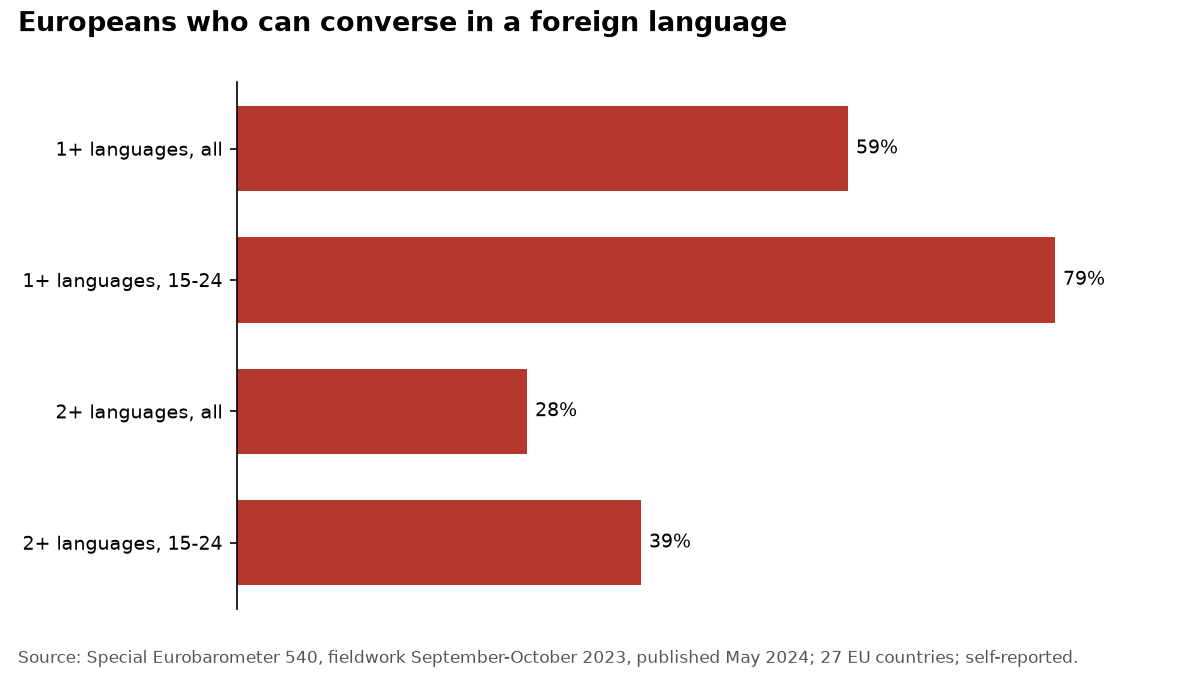
- In a survey fielded in 2023, 59% of Europeans said they can have a conversation in at least one foreign language. European Commission, Europeans’ language skills, data year 2023.
- Among Europeans aged 15 to 24, 79% can converse in a language other than their mother tongue, up 5 percentage points since 2012. Special Eurobarometer 540, data year 2023.
- In the same survey, 28% of Europeans can converse in more than one foreign language. Special Eurobarometer 540, data year 2023.
- Among young Europeans, 39% can converse in more than one foreign language. Special Eurobarometer 540, data year 2023.
- About half of Europeans (47%) speak English as a foreign or second language, up 5 percentage points since 2012. Special Eurobarometer 540, data year 2023.
- In the same survey, 86% of EU citizens agreed that everyone should speak at least one language other than their mother tongue. Special Eurobarometer 540, data year 2023.
Languages spoken at home in the US and Canada
The number of US residents speaking another language at home has roughly tripled since 1980, and Spanish accounts for most of them.
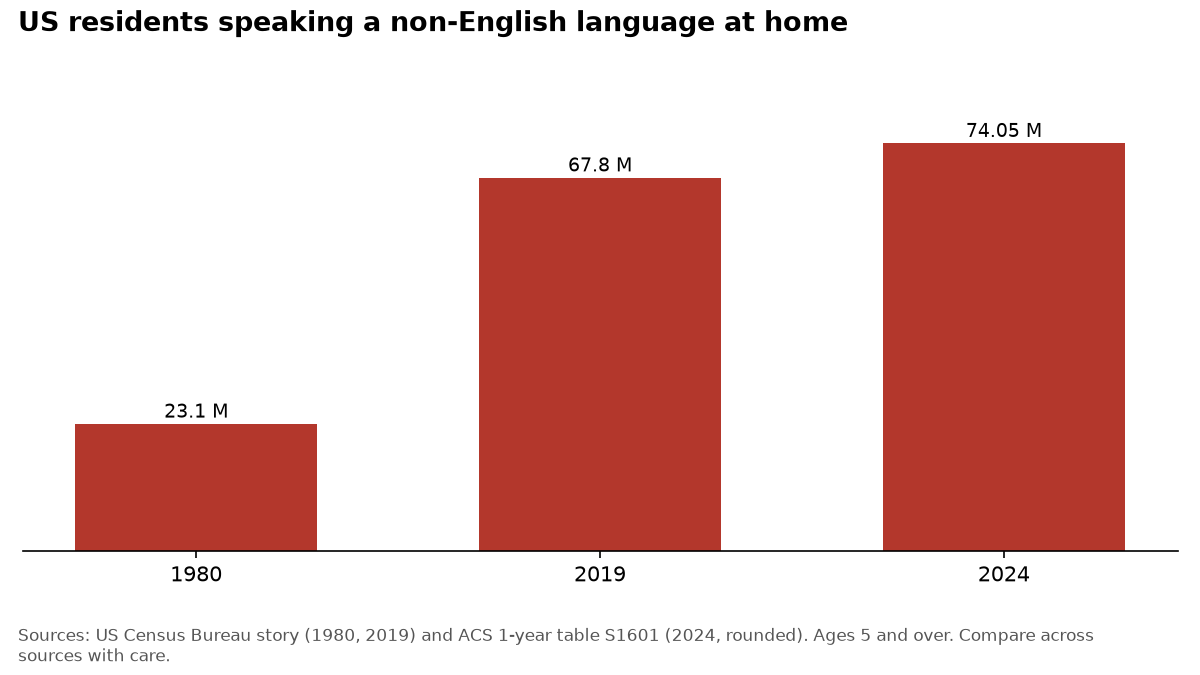
- In 2024, 74,050,833 US residents aged 5 and over spoke a language other than English at home, per American Community Survey estimates. US Census Bureau, ACS 1-year table S1601 (2024), data year 2024.
- That equals about 23.0% of the 321,745,943 US residents aged 5 and over in 2024 (74,050,833 divided by 321,745,943). US Census Bureau, ACS 1-year table S1601 (2024), data year 2024.
- An estimated 44,867,699 US residents aged 5 and over spoke Spanish at home in 2024. US Census Bureau, ACS 1-year table S1601 (2024), data year 2024.
- An estimated 247,695,110 US residents aged 5 and over spoke only English at home in 2024. US Census Bureau, ACS 1-year table S1601 (2024), data year 2024.
- The number of US residents speaking a non-English language at home rose from 23.1 million in 1980 to 67.8 million in 2019. US Census Bureau, Nearly 68 Million People Spoke a Language Other Than English at Home, data year 2019.
- Spanish was the most common non-English language in US homes in 2019, at 62%, per the Census Bureau. US Census Bureau, Nearly 68 Million People Spoke a Language Other Than English at Home, data year 2019.
- More than half (55%) of US Spanish speakers were US-born in 2019. US Census Bureau, Nearly 68 Million People Spoke a Language Other Than English at Home, data year 2019.
- In Canada’s 2021 census, 4.6 million people spoke a language other than English or French predominantly at home. Statistics Canada, languages spoken at home infographic, data year 2021.
- That group is 12.7% of Canada’s population, according to Statistics Canada’s 2021 census data. Statistics Canada, languages spoken at home infographic, data year 2021.
Language study in US schools and colleges
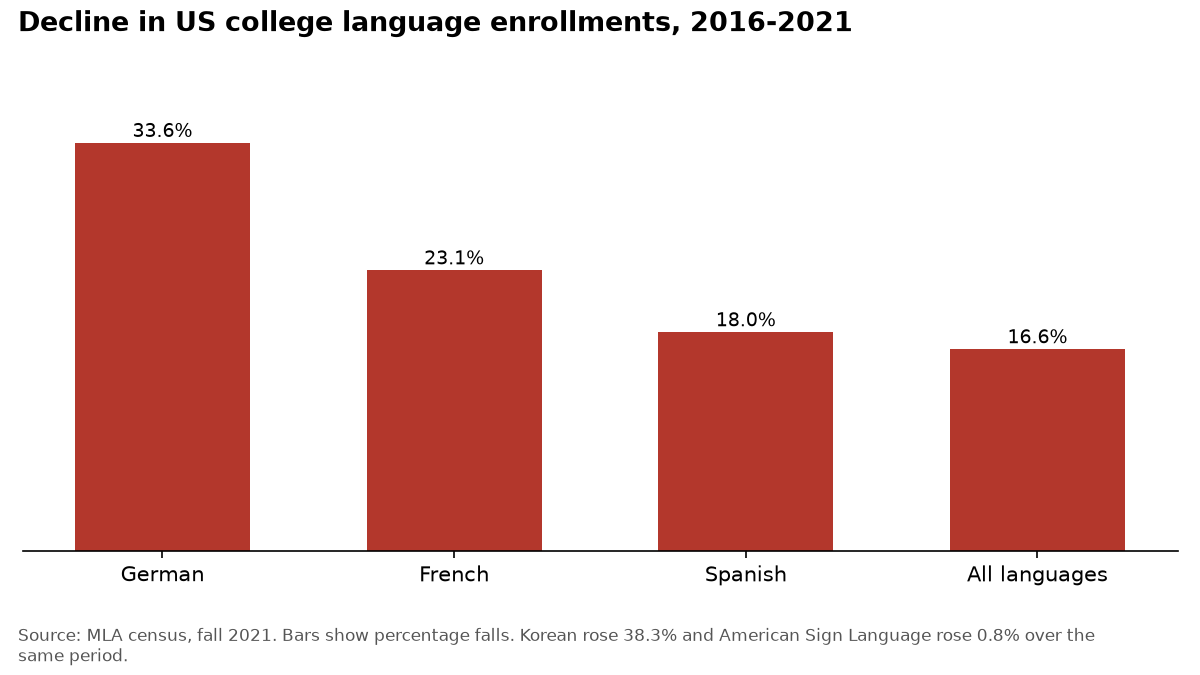
Fewer than half of US public schools offer a world language, and college enrollments fell sharply through 2021, with Korean a notable exception.
- In January 2024, 43% of US public schools reported offering world language classes. ACTFL, The State of K-12 World Language Education (2026), using NCES data, data year 2024.
- Only 20% of US public elementary schools offered world language classes in January 2024. ACTFL, The State of K-12 World Language Education (2026), using NCES data, data year 2024.
- In January 2024, 61% of US middle or combined schools offered world languages. ACTFL, The State of K-12 World Language Education (2026), using NCES data, data year 2024.
- In January 2024, 82% of US public high schools offered world languages. ACTFL, The State of K-12 World Language Education (2026), using NCES data, data year 2024.
- In January 2024, 92% of US public schools with 1,000 or more students offered world languages. ACTFL, The State of K-12 World Language Education (2026), using NCES data, data year 2024.
- Among US public high schools in January 2024, 79% offered Spanish and 34% offered French. ACTFL, The State of K-12 World Language Education (2026), using NCES data, data year 2024.
- Of US public schools offering world languages, 76% taught them in traditional classrooms in January 2024, while 19% taught online. ACTFL, The State of K-12 World Language Education (2026), using NCES data, data year 2024.
- US college enrollments in languages other than English fell 16.6% between fall 2016 and fall 2021, while all college enrollments fell 8.0%. Modern Language Association, Enrollments in Languages Other Than English, Fall 2021, data year 2021.
- US colleges reported 1,182,562 language enrollments in fall 2021, about the same as 1998. Modern Language Association, Enrollments in Languages Other Than English, Fall 2021, data year 2021.
- US college language enrollments fell 29.3% between 2009 and 2021. Modern Language Association, Enrollments in Languages Other Than English, Fall 2021, data year 2021.
- German enrollments at US colleges fell 33.6% between 2016 and 2021, the biggest drop among commonly taught languages. Modern Language Association, Enrollments in Languages Other Than English, Fall 2021, data year 2021.
- Spanish enrollments at US colleges fell 18.0% between 2016 and 2021, while French fell 23.1%. Modern Language Association, Enrollments in Languages Other Than English, Fall 2021, data year 2021.
- Korean enrollments at US colleges rose 38.3% between 2016 and 2021. Modern Language Association, Enrollments in Languages Other Than English, Fall 2021, data year 2021.
- In fall 2021, 5.3 million US public school students were English learners. NCES Fast Facts: English learners, data year 2021.
- English learners were 10.6 percent of US public school students in fall 2021, up from 9.4 percent in fall 2011. NCES Fast Facts: English learners, data year 2021.
Language exams and teaching in England
Spanish leads French in provisional GCSE entries in England, while language uptake still tracks school affluence.
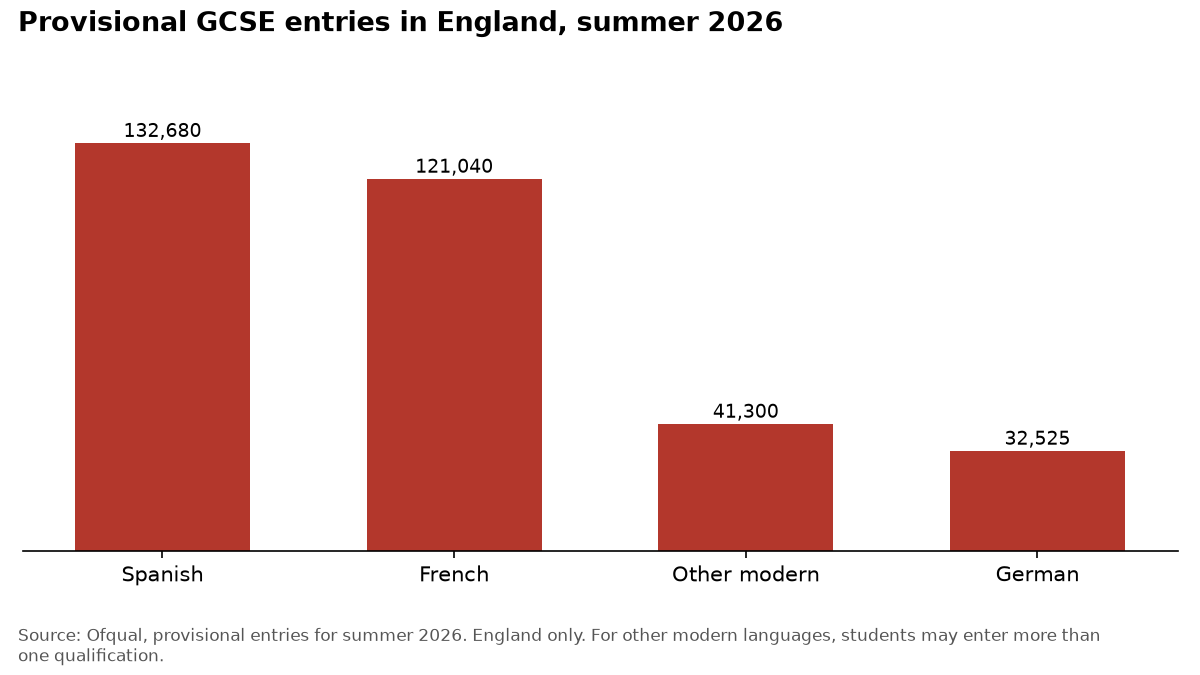
- Spanish had 132,680 provisional GCSE entries in England for summer 2026, up 0.5% from 2025. Ofqual, Provisional entries for GCSE, AS and A level: summer 2026, data year 2026.
- French had 121,040 provisional GCSE entries in England for summer 2026. Ofqual, Provisional entries for GCSE, AS and A level: summer 2026, data year 2026.
- French GCSE entries in England fell 5.5% from summer 2025 to summer 2026. Ofqual, Provisional entries for GCSE, AS and A level: summer 2026, data year 2026.
- German had 32,525 provisional GCSE entries in England for summer 2026, up 0.3% from 2025. Ofqual, Provisional entries for GCSE, AS and A level: summer 2026, data year 2026.
- Other modern languages had 41,300 provisional GCSE entries in England for summer 2026, down 3.8%. Ofqual, Provisional entries for GCSE, AS and A level: summer 2026, data year 2026.
- Spanish GCSE entries in England grew from 116,355 in summer 2022 to 132,680 in summer 2026. Ofqual, Provisional entries for GCSE, AS and A level: summer 2026, data year 2026.
- Spanish had 7,905 provisional A level entries in England for summer 2026. Ofqual, Provisional entries for GCSE, AS and A level: summer 2026, data year 2026.
- French had 6,465 provisional A level entries in England for summer 2026. Ofqual, Provisional entries for GCSE, AS and A level: summer 2026, data year 2026.
- German had 2,190 provisional A level entries in England for summer 2026, up 3.1%. Ofqual, Provisional entries for GCSE, AS and A level: summer 2026, data year 2026.
- In a 2025 British Council survey, 68% of England’s least affluent schools reported difficulty recruiting language teachers. British Council, Language Trends England 2025, data year 2025.
- Language GCSE uptake is more than 20 percentage points higher in England’s most affluent state schools, says the British Council’s 2025 report, which surveyed teachers at more than 1,000 schools. British Council, Language Trends England 2025, data year 2025.
Proficiency tests and exam demand
JLPT applications rose between 2024 and 2025. English test averages differ by group, but ETS and EF both warn that their test takers are not a representative sample.
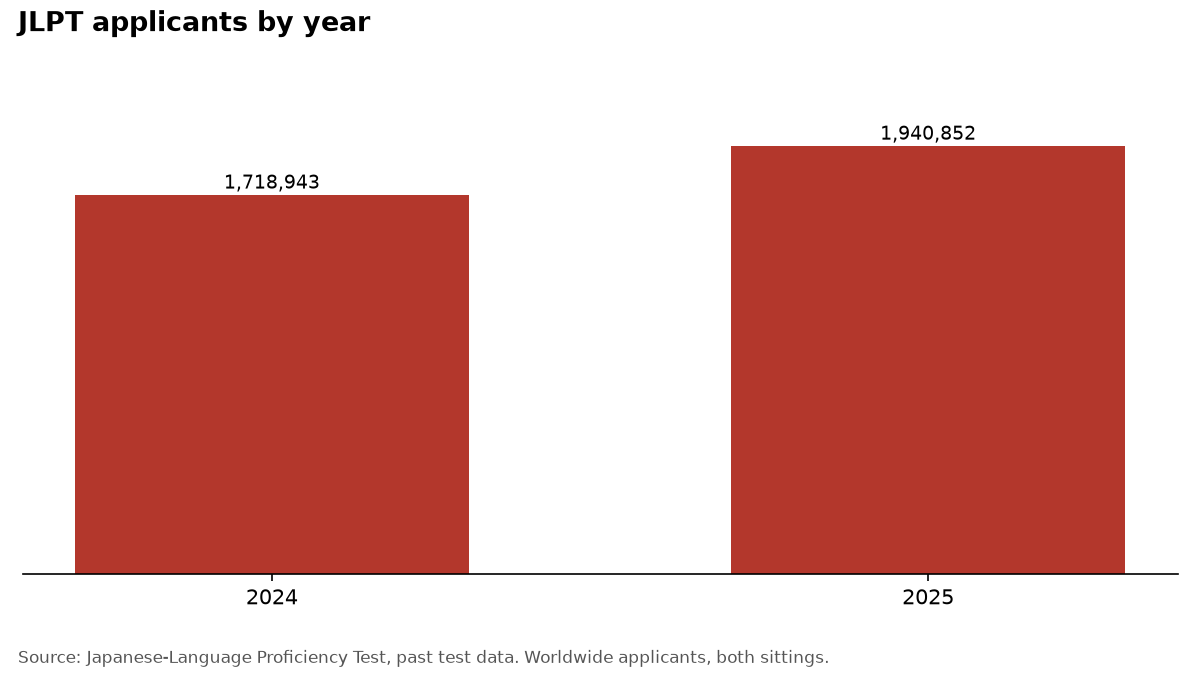
- The Japanese-Language Proficiency Test drew 1,940,852 applicants in 2025, up from 1,718,943 in 2024. Japanese-Language Proficiency Test, past test data, data year 2025.
- A total of 1,645,713 people sat the JLPT in 2025, including those who took only some sections. Japanese-Language Proficiency Test, past test data, data year 2025.
- The JLPT was held in 92 countries and areas in 2025. Japanese-Language Proficiency Test, past test data, data year 2025.
- The 2025 EF English Proficiency Index draws on more than 2,200,000 people who took EF’s test in 2024, a self-selected group EF says is not guaranteed to be representative. EF English Proficiency Index 2025, methodology, data year 2024.
- The 2025 EF English Proficiency Index covers 123 countries and regions. EF English Proficiency Index 2025, data year 2025.
- The Netherlands ranks first on the 2025 EF English Proficiency Index with a score of 624. EF English Proficiency Index 2025, data year 2025.
- A TOEFL iBT total score of 100 sat at the 74th percentile of test takers in 2025. ETS, TOEFL iBT Test and Score Data Summary 2025, data year 2025.
- Native Chinese speakers averaged 87 on the TOEFL iBT in 2025, though ETS says its test takers are not representative of all speakers. ETS, TOEFL iBT Test and Score Data Summary 2025, data year 2025.
- Native Japanese speakers averaged 73 on the TOEFL iBT in 2025, under the same ETS caution about comparing groups. ETS, TOEFL iBT Test and Score Data Summary 2025, data year 2025.
- The mean IELTS Listening score was 6.45 on the 9-band scale in 2024-25. IELTS, test statistics 2024-25, data year 2025.
- The mean IELTS Academic Reading score was 6.32 on the 9-band scale in 2024-25. IELTS, test statistics 2024-25, data year 2025.
The language app business
Duolingo, which reports its results publicly, is growing its daily audience much faster than its paying base.
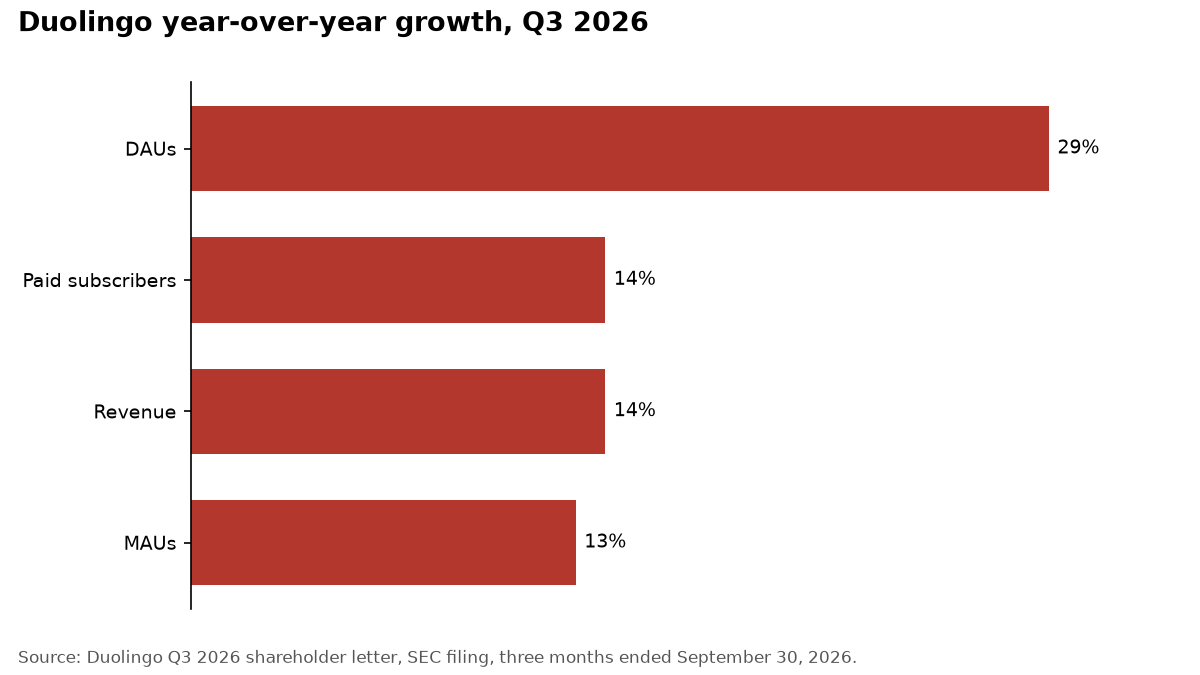
- Duolingo averaged 64.9 million daily active users in Q3 2026, up 29% year over year. Duolingo Q3 2026 shareholder letter (SEC filing), data year 2026.
- Duolingo reported 153.1 million monthly active users in Q3 2026, up 13% year over year. Duolingo Q3 2026 shareholder letter (SEC filing), data year 2026.
- Duolingo ended Q3 2026 with 13.1 million paid subscribers, up 14% year over year. Duolingo Q3 2026 shareholder letter (SEC filing), data year 2026.
- Duolingo’s Q3 2026 revenue was $309.0 million, up 14% year over year. Duolingo Q3 2026 shareholder letter (SEC filing), data year 2026.
- Duolingo’s Q3 2026 total bookings were $316.1 million, up 12% year over year. Duolingo Q3 2026 shareholder letter (SEC filing), data year 2026.
- Duolingo’s Q3 2026 subscription bookings were $278.4 million, up 16% year over year. Duolingo Q3 2026 shareholder letter (SEC filing), data year 2026.
- Duolingo’s adjusted EBITDA was $78.7 million in Q3 2026, a 25.5% margin. Duolingo Q3 2026 shareholder letter (SEC filing), data year 2026.
- Duolingo’s net income was $27.2 million in Q3 2026. Duolingo Q3 2026 shareholder letter (SEC filing), data year 2026.
- Duolingo guided to about $1,221 million of revenue for full-year 2026, a company forecast rather than a result. Duolingo Q3 2026 shareholder letter (SEC filing), data year 2026.
How long it takes and what the evidence shows
Published timelines run from hundreds to thousands of hours, and the app evidence is limited, narrow and often linked to the vendor.
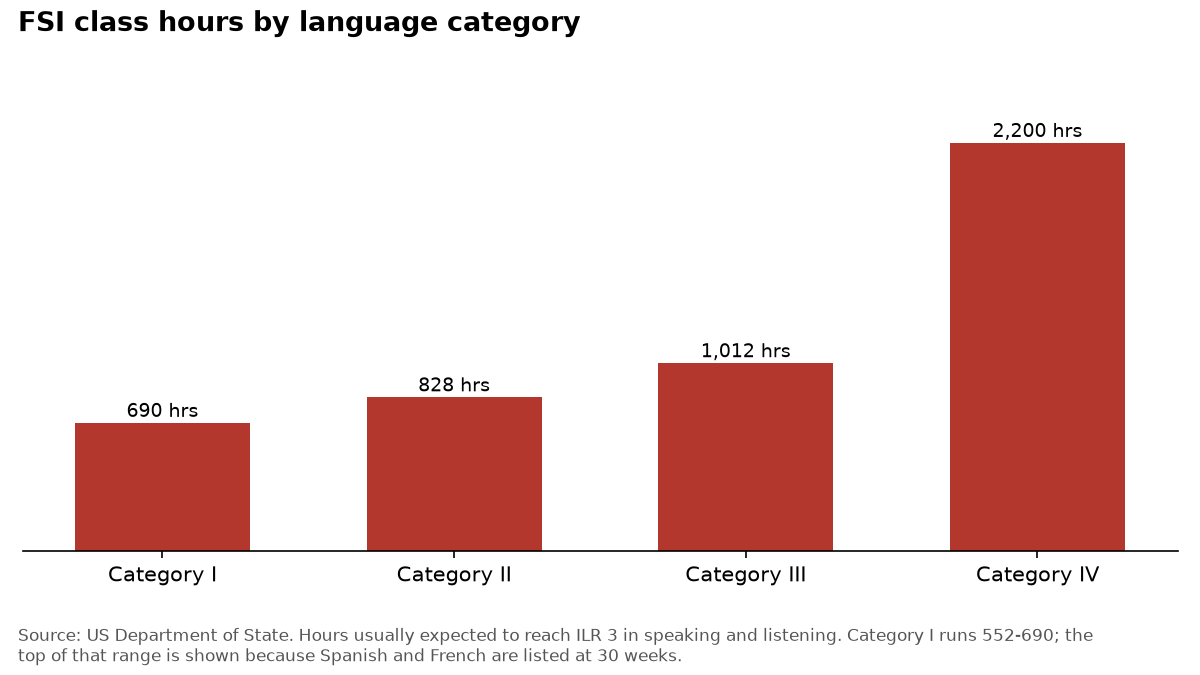
- The US Foreign Service Institute usually expects Category I languages to take 552-690 class hours to reach ILR level 3 in speaking and listening, with Spanish and French listed at 30 weeks. US Department of State, Foreign Language Training, data year 2026.
- Category II languages such as German take about 828 class hours at the Foreign Service Institute. US Department of State, Foreign Language Training, data year 2026.
- Category III languages such as Russian and Hindi take about 1,012 class hours at the Foreign Service Institute. US Department of State, Foreign Language Training, data year 2026.
- Category IV languages, including Arabic, Japanese, Korean and Mandarin, take 2200 class hours at the Foreign Service Institute. US Department of State, Foreign Language Training, data year 2026.
- A typical week at the Foreign Service Institute is 23 hours in class plus 17 hours of self-study. US Department of State, Foreign Language Training, data year 2026.
- Cambridge English says it takes approximately 200 guided learning hours to move up one CEFR level. Cambridge English, Guided learning hours, data year 2026.
- Cambridge English suggests 350—400 guided learning hours from beginner to B1, as a guideline for English. Cambridge English, Guided learning hours, data year 2026.
- Cambridge English suggests 500—600 guided learning hours from beginner to B2. Cambridge English, Guided learning hours, data year 2026.
- Cambridge English suggests 700—800 guided learning hours from beginner to C1. Cambridge English, Guided learning hours, data year 2026.
- Cambridge English suggests 1,000—1,200 guided learning hours from beginner to C2. Cambridge English, Guided learning hours, data year 2026.
- A 2021 study in Foreign Language Annals tested 225 adult US Duolingo learners who had completed beginning-level Spanish or French courses. Jiang et al., Foreign Language Annals (2021), data year 2021.
- Those learners reached Intermediate Low in reading and Novice High in listening, with no other skills assessed; level names here are ACTFL ratings from the 2021 study. Jiang et al., Foreign Language Annals (2021), data year 2021.
- Their reading and listening scores were comparable with those of university students at the end of the fourth semester of study, the 2021 study reports. Jiang et al., Foreign Language Annals (2021), data year 2021.
- A 2021 Duolingo Research Report by largely the same authors tested 340 learners who had finished the first seven units of Spanish or French on Duolingo. Duolingo Research Report DRR-21-03, data year 2021.
- Across both languages, those 340 learners spent a median of 203 hours on the first seven units, and reached Intermediate Mid/High in reading and Intermediate Low in listening. Duolingo Research Report DRR-21-03, data year 2021.
- Each participant in that 2021 Duolingo Research Report was paid $100 after completing both tests. Duolingo Research Report DRR-21-03, data year 2021.
- Six of the seven authors of that report are listed with a Duolingo, Inc. affiliation, and the seventh with Northern Arizona University (a count of the author list). Duolingo Research Report DRR-21-03, data year 2021.
Language jobs and the language industry
The dedicated US interpreter and translator profession is small and slow-growing, inside a large but fragmented global industry.
- The US had 73,900 interpreter and translator jobs in 2025. US Bureau of Labor Statistics, Occupational Outlook Handbook, data year 2025.
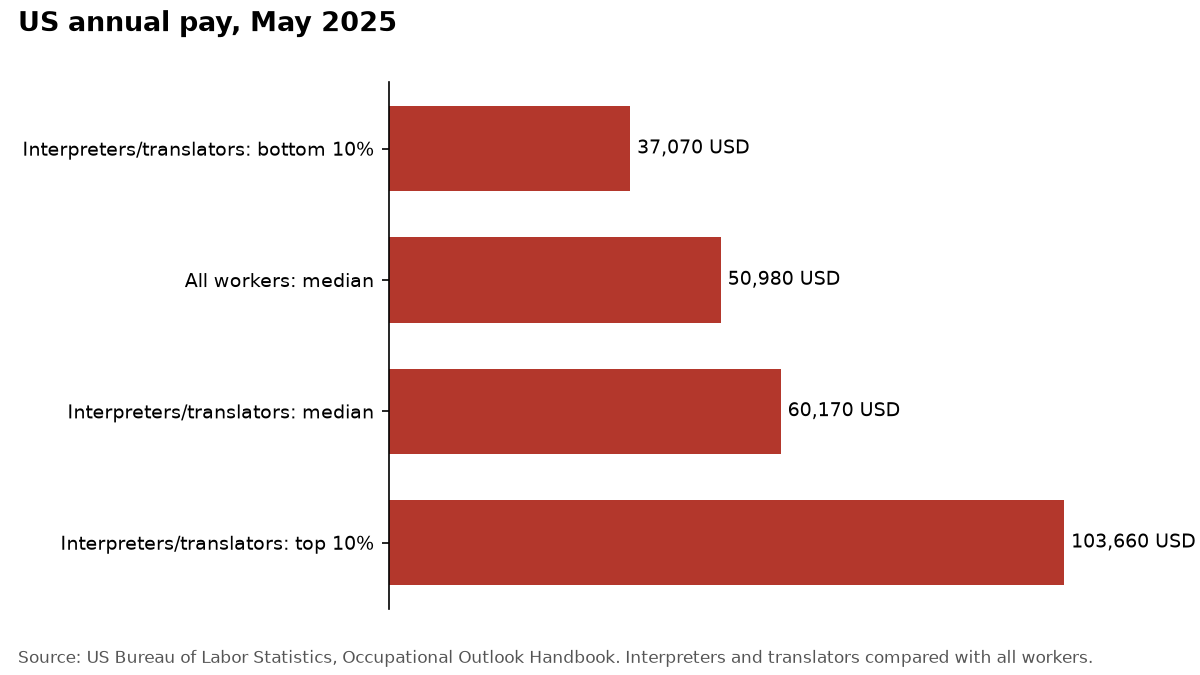
- The median annual wage for US interpreters and translators was $60,170 in May 2025. US Bureau of Labor Statistics, Occupational Outlook Handbook, data year 2025.
- The median annual wage for all US workers was $50,980 in May 2025. US Bureau of Labor Statistics, Occupational Outlook Handbook, data year 2025.
- The lowest-paid 10 percent of US interpreters and translators earned less than $37,070 in May 2025. US Bureau of Labor Statistics, Occupational Outlook Handbook, data year 2025.
- The highest-paid 10 percent of US interpreters and translators earned more than $103,660 in May 2025. US Bureau of Labor Statistics, Occupational Outlook Handbook, data year 2025.
- US interpreter and translator employment is projected to grow 2 percent from 2025 to 2035, slower than the average. US Bureau of Labor Statistics, Occupational Outlook Handbook, data year 2025.
- About 6,000 US interpreter and translator openings are projected each year on average over the decade to 2035. US Bureau of Labor Statistics, Occupational Outlook Handbook, data year 2025.
- Self-employed workers were the second-largest group among US interpreters and translators in 2025, at 28 percent of jobs. US Bureau of Labor Statistics, Occupational Outlook Handbook, data year 2025.
- Nimdzi estimates the language industry at USD 72.6 billion in 2025. Nimdzi 100, 2026, data year 2025.
- Nimdzi projects the language industry at USD 73.4 billion in 2026. Nimdzi 100, 2026, data year 2026.
- The 100 largest language industry providers made up 19.8% of the industry in 2025, according to Nimdzi. Nimdzi 100, 2026, data year 2025.
- North America accounted for USD 30.6 billion of language services bought in 2025, according to Nimdzi. Nimdzi 100, 2026, data year 2025.
Frequently Asked Questions
How many languages are there in the world?
Ethnologue counts 7,170 languages in use today and estimates that roughly 44% are endangered. It says the total is constantly changing.
How many people speak Spanish?
It depends on the definition. Ethnologue’s 2026 list gives 561.3M total speakers. Instituto Cervantes counts 635,743,644 potential users in 2025: 519,115,258 native, 92,068,243 with limited competence and 24,560,143 learners.
What is the most studied language in the world?
We found no single global count, but English leads the measures on this page. It ranks first on Duolingo in 154 countries, and 89.4% of EU upper secondary pupils studied it in 2024.
How many people use Duolingo?
Duolingo reported an average of 64.9 million daily active users and 153.1 million monthly active users in Q3 2026, with 13.1 million paid subscribers at the end of the quarter.
What percentage of Americans speak another language at home?
About 23.0% of US residents aged 5 and over in 2024, or an estimated 74,050,833 of 321,745,943 people, based on American Community Survey estimates.
How long does it take to learn a language?
Published benchmarks vary widely. The US Foreign Service Institute usually expects 552-690 class hours for Category I languages and 2200 for Category IV, to reach ILR level 3 in intensive training. Cambridge English suggests 500—600 guided learning hours from beginner to B2 in English.
Methodology
We prefer the organisation that collected the data: statistics offices, regulators, language institutes, exam bodies, company filings and peer-reviewed research. No statistics roundups are cited. Each figure was located on the cited page and compared with the claim for population, unit, country and year. Most pages were checked with an automated script and then read. Pages that refuse automated requests or render with JavaScript were read in a browser, and PDFs were read with a text extraction tool; those stats carry a note in the source data. The year on a stat is the year the data describes. Some pages do not date the figures they give (the Foreign Service Institute, Cambridge English, UNESCO, parts of Ethnologue and the Francophonie), so those carry the year we read them, 2026. Read that as an access date, not a data year. The Eurobarometer survey was fielded in September-October 2023 and published in May 2024. Definitions differ and are not reconciled: learner counts for French, Spanish, German, Japanese and Korean use different scopes, and speaker totals for Spanish and French differ between publishers. We report each with its source and do not rank them against each other. Vendor figures reflect their own users or test takers, and are not independent measures of all learners. Duolingo’s rankings describe Duolingo learners. EF says its test takers are self-selected, and ETS says ranking countries on TOEFL scores is a misuse of data. The two outcome studies cited share most of their authors, and the Duolingo Research Report lists six of its seven as Duolingo staff. Older data appears where we found nothing newer: the MLA census (fall 2021), NCES English learner data (fall 2021), the German survey (2020) and the Statistics Canada census (2021). The Census Bureau story (2019 data) is kept for its long-run comparison and speaker detail; the current US counts come from the 2024 American Community Survey table, whose margins of error are on the Census page. Two sources we wanted could not be read and are left out: a New American Economy report on bilingual job postings and a 2018 Cognition study on the critical period for language learning. Lingostar has no first-party data here and claims no hands-on testing. We plan to review this page each quarter and when a major source updates; the next review is due February 5, 2027.
Last verified November 5, 2026. Next review due February 5, 2027.
Sources
- ACTFL, The State of K-12 World Language Education (2026), using NCES data
- British Council, Language Trends England 2025
- Cambridge English, Guided learning hours
- Deutsch als Fremdsprache weltweit 2020 (German Federal Foreign Office and partners, via Goethe-Institut)
- Duolingo Language Report 2025
- Duolingo Q3 2026 shareholder letter (SEC filing)
- Duolingo Research Report DRR-21-03
- EF English Proficiency Index 2025
- EF English Proficiency Index 2025, methodology
- Ethnologue 200, 2026 list
- Ethnologue, How many languages are there
- ETS, TOEFL iBT Test and Score Data Summary 2025
- European Commission, Europeans’ language skills
- Eurostat, Foreign language learning statistics
- IELTS, test statistics 2024-25
- Instituto Cervantes, El español: lengua para el mundo 2025
- Japan Foundation, Survey on Japanese-Language Education Abroad 2024
- Japanese-Language Proficiency Test, past test data
- Jiang et al., Foreign Language Annals (2021)
- Modern Language Association, Enrollments in Languages Other Than English, Fall 2021
- NCES Fast Facts: English learners
- Nimdzi 100, 2026
- Ofqual, Provisional entries for GCSE, AS and A level: summer 2026
- Organisation internationale de la Francophonie
- South Korea Ministry of Culture, Sports and Tourism
- Special Eurobarometer 540
- Statistics Canada, languages spoken at home infographic
- UNESCO, International Mother Language Day
- US Bureau of Labor Statistics, Occupational Outlook Handbook
- US Census Bureau, ACS 1-year table S1601 (2024)
- US Census Bureau, Nearly 68 Million People Spoke a Language Other Than English at Home
- US Department of State, Foreign Language Training